AI-Powered Content Creation: From Ideas to Engaging Visual Stories
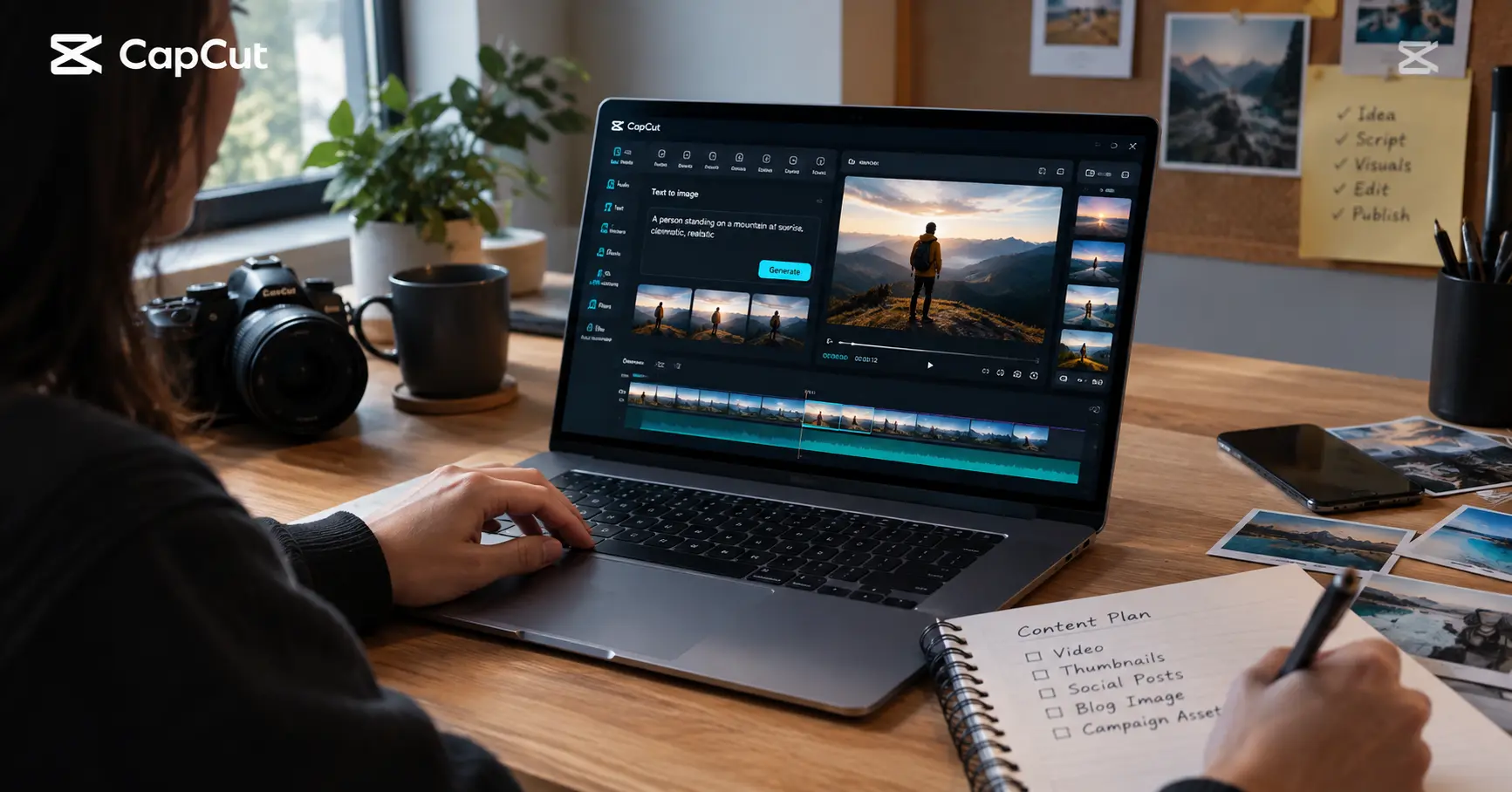
Although conceptualizing digital content might be an easy job, the process of creating high-quality visual products from this initial idea involves many challenges. An AI video editor with ChatGPT can help creators approach video production more efficiently by bringing intelligent assistance closer to the creative process.
A social media campaign could require only a handful of short videos, the accompanying visuals for promotion and thumbnails, illustrations and additional assets. Previously, it was an elaborate creative process and required software skills for each element. AI is transforming that process by linking various content creation phases. This is particularly beneficial for creators who require the ability to create eye-catching visual content repeatedly without giving up creative control and freedom.
From Creative Ideas to Finished Content
Don’t always have a problem with ideas. Many times, there are ideas out there, and the creators just don’t know how to get those ideas to fruition with Faith. There are a great deal of concepts out there and a great deal of creators who just can’t go from idea to asset in a snap.
You could start with a written idea, then write a script, create visual notes, decide on shots, edit the shots, write scripts for the images, make final edits and video adjustments prior to delivery. Likewise, one campaign can involve multiple original images that are consistent with the general appearance and information of the video.
With AI, the gap between conception and action is bridged. In contrast to traditional production, in which workers have to implement the entire creative workflow from scratch, users can draw on intelligent systems for certain work steps. It is important to understand that not all decisions must become automated. AI is capable of working on all the tedious or lengthy processes so creators will be left with the freedom to devote their attention to the content, the form, and the quality of the end product.
Conversational AI Is Changing Video Workflows
One notable development in creative technology is the use of conversational interfaces. With traditional editing applications, users need to first learn about menus, timelines, effects or technical features in order to obtain the desired result. Conversational AI brings a more straightforward option for expressing creativity. Instead of thinking only in terms of software functions, users can describe what they want to accomplish and use intelligent assistance as part of the workflow.
For creators exploring this approach, an AI video editor with ChatGPT can represent a different way of thinking about video production. The emphasis has shifted from only using editing software to coming up with creative ideas and employing new technologies. This is very helpful for novices who know what they want but lack technical know-how. At the same time, experienced creators can adopt the technology to speed up repetitive tasks.
Why Context Matters in AI-Assisted Creation
AI output may not necessarily be useful because it can be generated quickly. In the production of an output, the context is significant in determining whether or not it is an appropriate fit for the project.
A business promoting a professional business would need to have a different visual style than a short, funnelled business social media video. The decisions regarding creativity are based on various factors, such as the purpose, brand image, platform, and target audience.
Indeed, it is important to have established rules and defined requirements while working with outside factors. The better the creative knows what kind of mood, content, structure, and style they want their work to convey, the easier it will be to determine whether the objectives have been met or not.
Connecting Video and Visual Content
In today’s world, video is not a standalone marketing strategy. When creating a video for YouTube, a creator might require a thumbnail; when posting content on social media, they may need to boost a photo; when writing an article, they might need to include a graphic; and when announcing a new product, they’ll need to create a visual concept.
This allows an opportunity for a consistent visual identity in various guises. For example, a creator may establish a specific colour direction, use a style, or an unforgettable visual style which they can then change across videos and photos. With consistency, users will more easily identify the material of interest, and each asset can be used to its fullest benefit.
In that case, AI can help make the process more flexible, so that less manual effort is needed in exploring various visual ideas.
Text-to-Image Technology Expands Creative Possibilities
Creating a suitable visual traditionally required photography, illustration skills, stock-image research, or graphic design software. While these approaches remain valuable, text-to-image technology offers another option for exploring visual concepts.
Creators can describe an environment, object, ambience, or design concept and use artificial intelligence to produce an image from that description. This is helpful in the brainstorming process as it allows numerous alternatives to be considered before determining the final visual concept.
An AI image generator from text can therefore become part of a broader content workflow rather than being used only as an independent design feature. Pictures can help in video clips, blog articles, speeches, adverts, snapshots of videos, different social channels, and so on. However, the graphics must always be analyzed. The criteria for choosing images for publishing are composition, realism, branding, precise meaning, and usefulness.
Building a More Efficient Multimedia Workflow
It’s more clearly possible to see the real value of AI when more than one creative task goes into action. Rather than producing individual pieces of content, creators can build a process that can be reused.
Research and idea development are among the first steps in a project, and a script or content outline will then follow. With AI-powered editing, video production can be complemented, and customized graphics can be generated to fit the created videos.
Once created, the information can then be implemented across other areas, such as the use of another discipline approach, adapted for other platforms, etc. A longer video might be divided into multiple clips in its entirety, and supporting images can be utilized for marketing posts or thumbnails.
This is not only quicker than editing, but this way of doing things will save you time as well. It also establishes a holistic approach to more easily manage regular content production.
Maintaining Authenticity in AI-Generated Content
The effectiveness of AI has a direct effect on the importance of originality and authenticity. As the power of AI grows, the importance of originality and authenticity also rises. The challenge is not just in the production of ideas, but also in realizing the ideas in such a way that they provide value to the intended users. This is why it is essential that content creators do not rely solely on computer-generated ideas or on the ideas given by the algorithm.
Making the content of one’s work unique can be achieved by means of merging technology with one’s personal experience, original storytelling technique, experience of living, etc. It is fundamental that creators pay attention to editing the content given to them through AI. If it has major flaws, such as awkward tone or incorrect facts, the content will be deprived of its quality.
Choosing AI Tools Based on the Creative Goal
There isn’t one universal AI workflow that can be applied to all creators. Speed and platform-specific formats can be my top concerns when I am using social media to manage, whereas detailed control and visual consistency can be mine when I am a filmmaker.
Likewise, the specificity of certain tools, combining multiple creative features, could well suit the needs of a small business, while AI capabilities for a professional editor could be part of a production workflow.
Therefore, the creators need to assess AI tools relative to the specific problems they are trying to solve. Questions such as the information value of saving time/keeping a meaningful time constraint, the way it allows for creative experimentation, the control possibilities it gives and the ease with which a tool can be integrated into the production process are relevant. Technology should be used to achieve the creative objective and not as an end in itself.
The Future of Integrated AI Content Creation
The separation of writing, image making, video editing, and design can be viewed as becoming less rigid. Developers will be able to switch between these tasks in workflows rather than viewing each one individually, as AI technology evolves.
This might help people and small groups to access the creation of multimedia creations that typically require multiple areas of technical expertise. Simultaneously, experienced developers have the possibility to use insights to test out a number of ideas without exponentially raising the amount of time spent on production.
Despite these advancements, the creative role of mankind will be influential. While AI can come up with ideas, speed up the creation process, and help with technical aspects, it is up to the creators to determine which ideas should be pursued and which final product is worth publishing.
Conclusion
AI is revolutionizing content creation with the added flexibility of video production, imagery, and creative planning. Intelligent technology is not a replacement for creativity, but rather a support to aid creators in the creative journey more efficiently.
The best strategy is to work with AI-powered tools alongside producer intuition, defined and focused creative objectives, and rigorous quality management. Video and image creation can now merge into a single workflow, giving creators more uniformity in creating visual stories and less time on repetitive tasks.
With these technologies constantly changing, the benefit will no longer only be to those who deploy the most AI. It will be the property of creators who know that they need to be original, in context, and doing user-focused work while making use of intelligent tools.
