Best CPM & CPC Ad Networks for Low-Traffic Websites (2026)
You’ve just built your website. Or maybe you’ve been blogging for about six months, but your traffic is still small — a couple hundred people a day, or maybe a thousand on a really good week. You’ve put real effort into your content. Now you want to start making some money from it.
Most “how to make money” guides don’t tell you this truth: Big ad platforms like Mediavine need 50,000 visitors every single month, and Raptive won’t even look at your site until you hit 100,000 views. If you’re a smaller publisher, those numbers can feel impossible to reach.
The good news? You don’t need huge traffic to make money from ads. There are plenty of good CPM and CPC ad networks out there that work just fine for low-traffic websites. They’ll accept you from day one — no minimum visitors, no long waiting lists, no traffic checks. Just sign up, place their ad code on your site, and start earning money every time someone sees or clicks on an ad.
This article covers the 10 best CPM and CPC ad networks that actually work for low-traffic websites. We explain how each works, earnings, pros, cons, and best fit. This article offers a clear path for new bloggers, niche sites, or new creators.
Let’s start earning.
Chapter 1: What are CPM and CPC Networks?
Before choosing an ad network, understand the payment models: CPM and CPC. These determine your payment. Knowing the difference helps you choose platforms.
What Is CPM?
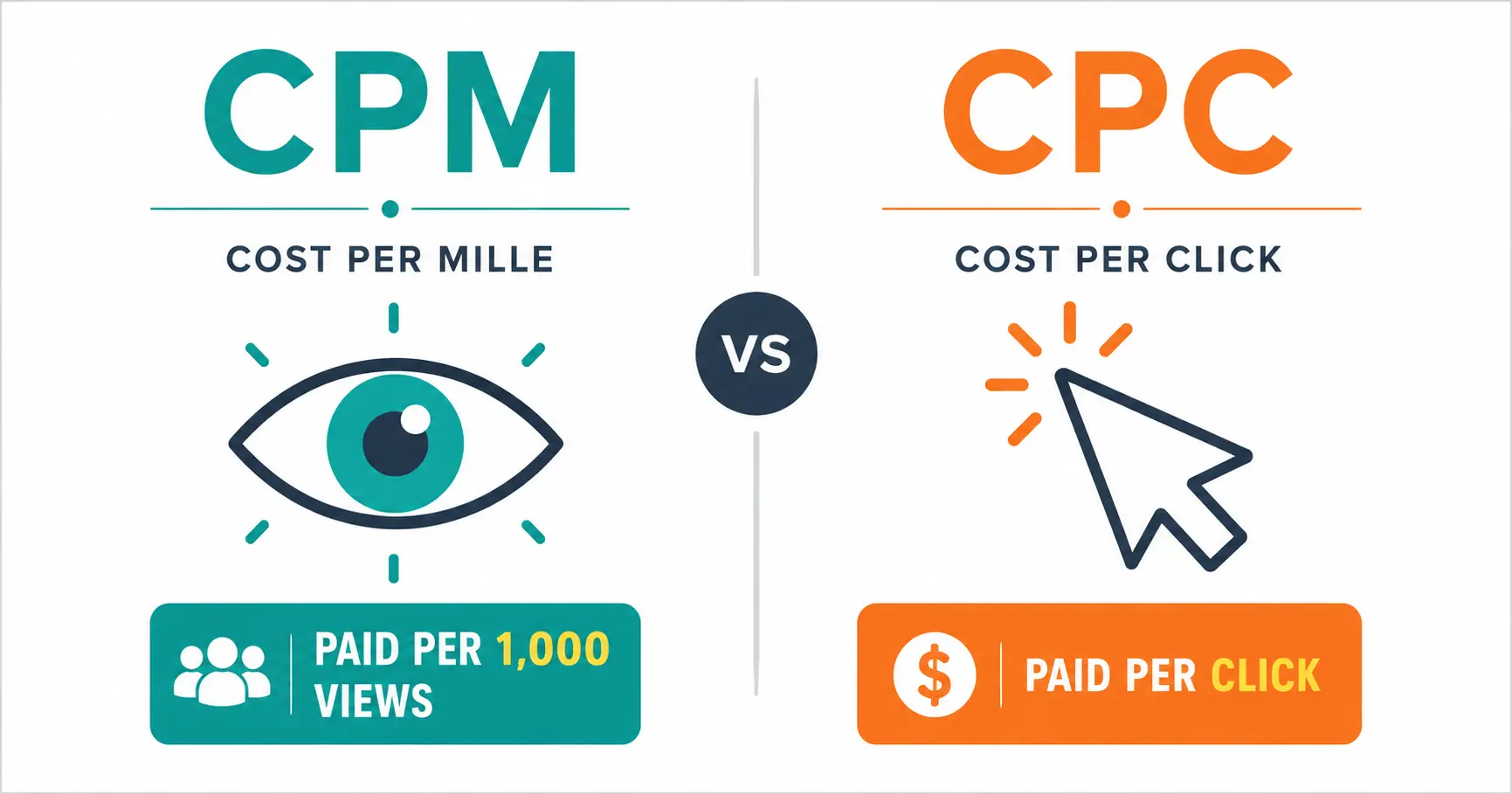
CPM, or “Cost Per Mille” (mille meaning thousand), is the amount an advertiser pays you for every 1,000 ad impressions on your site. As a website owner, you earn money just by having people visit your pages where ads appear. Nobody has to click on anything.
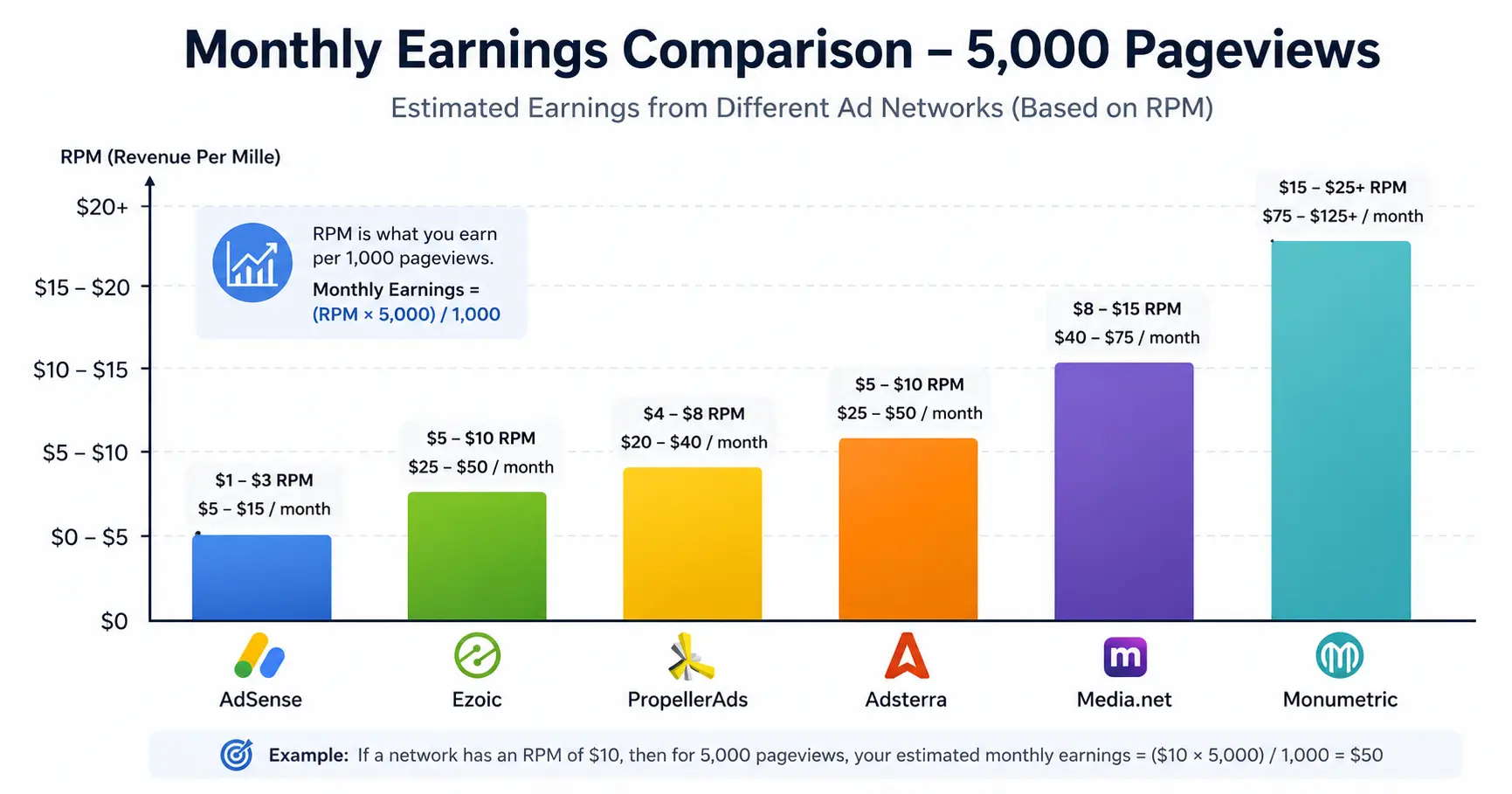
For example, if an ad network offers $2.00 CPM and your page gets 5,000 views in a month, you earn $10 from that network even if not a single person clicked an ad.
CPM works well when you have a lot of visitors. Even a small site with 10,000 monthly visitors can earn steady CPM income without needing people to click. That’s why CPM makes sense for small publishers even if your audience doesn’t click much, you still get paid just because they show up.
What Is CPC?
CPC stands for “Cost Per Click.” With CPC networks, you only earn money when a visitor actually clicks on an ad. The pay per click is usually higher than the per-view CPM rate. But your total earnings depend entirely on how many people click.
Google AdSense is the most famous CPC network, though these days it uses a mix of both models. CPC works well when your audience is really engaged and interacts with your content. You know engaged readers are valuable than large, and disengaged audiences.
Which model is better for low-traffic sites?
CPM and CPC are viable for small publishers. CPM networks pay you for visits, no clicks needed, great for sites where people browse but don’t click much. CPC networks reward you when your visitors actually engage. The smart move is to try both and stick with the one that makes you more money for your specific topic and audience behavior.
Many of the best networks on this list actually support both CPM and CPC at the same time. They automatically choose whichever pays you more per view. That mix is becoming pretty normal across the industry.
Chapter 2: Google AdSense: The First Ad Network Most Bloggers Try
Let us be honest here.
When most people think about making money from a site, AdSense will be the first thing that comes to mind.
It was the first ad network I heard about. It was probably the first one you heard about too.
The reason is AdSense has been around for years, and almost every blogging tutorial mentions it at some point.
The idea is simple.
You publish content. Google put ads on your website. You will earn some money based on views.
It may sound easy, isn’t it?
In reality, yes and no.
The good part is that AdSense doesn’t ask for massive traffic numbers.Neither Mediavine’s 50,000 monthly visitors nor Raptive’s 100,000 pageviews are necessary. Even relatively small websites can get approved if they have original content and follow Google’s rules.
That’s one of the reasons so many beginners start with AdSense.
I still remember my first AdSense’s earning. Cheaper than a cup of coffee. But it was proof that a website could actually generate money.
For most new bloggers, that first dollar matters more than the amount itself.
Of course, AdSense isn’t perfect.
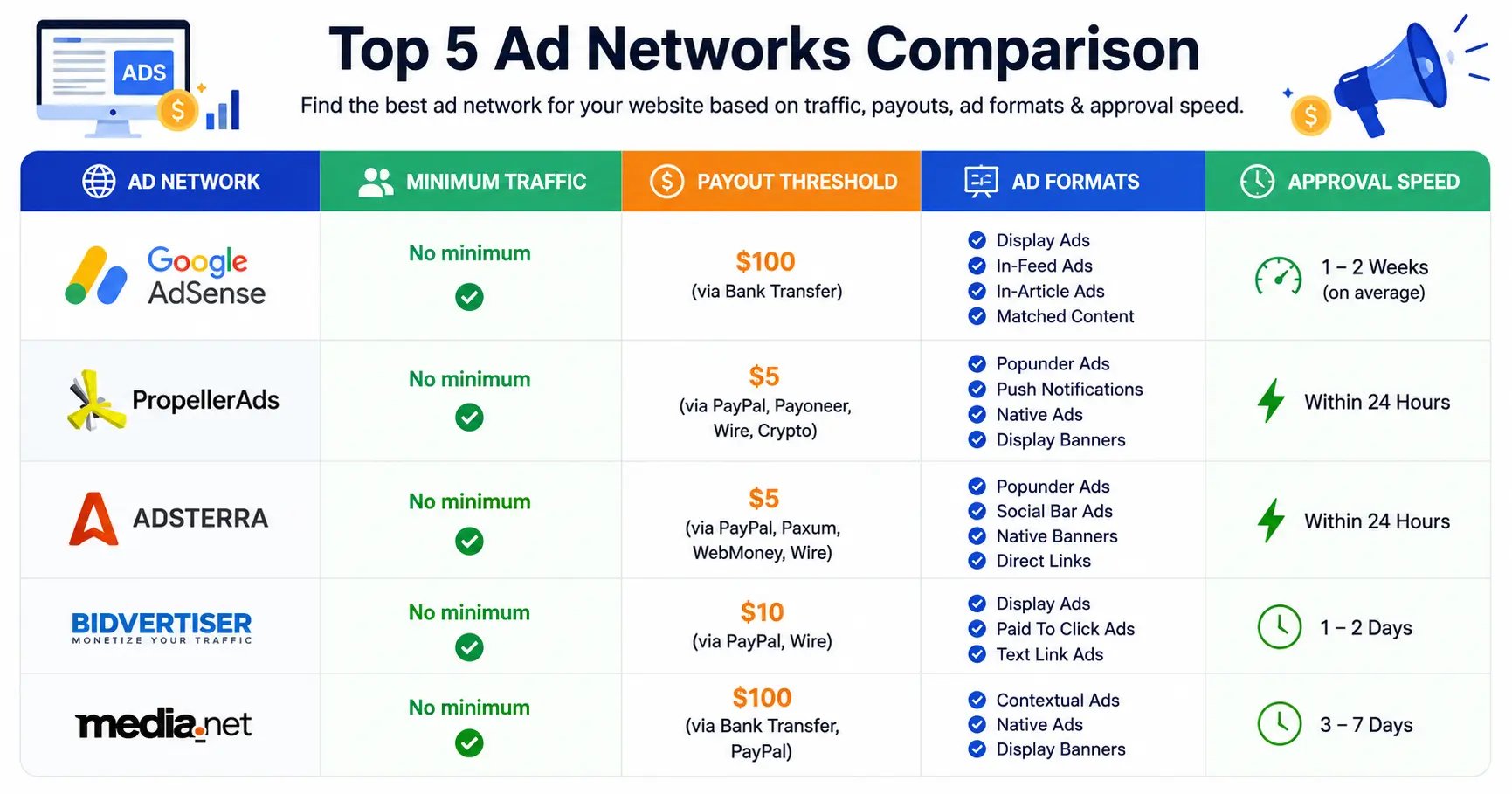
One thing that frustrates many small publishers is the payment threshold. Google won’t send your earnings until you reach $100. If your website earns little monthly, expect a delay in receiving your first payment.
Some bloggers also struggle with the approval process. One site gets approved quickly. Another gets rejected for some reason. It is just an experience.
Still, AdSense is worthy.
AdSense’s ads are clean, professional, and relevant. They do not deliver useless pop-ups and spammy content. It’s an easy starting point for niche blogs (technology, travel, food, personal finance, education, or DIY) to learn about display advertising, though it won’t make you rich quickly.
Apply for Google AdSense at adsense.google.com.
Chapter 3: Ezoic: Ad Network Many Bloggers Try After AdSense
If AdSense is the first option for most bloggers, then Ezoic is the next choice.
Ezoic was a frequent topic in blogging groups. When someone asked how to increase ad revenue, the same advice kept appearing:
“Try Ezoic. You may earn more than AdSense.”
We thought this recommendation is overhyped. But we realized why so many publishers talk about it after proper research.
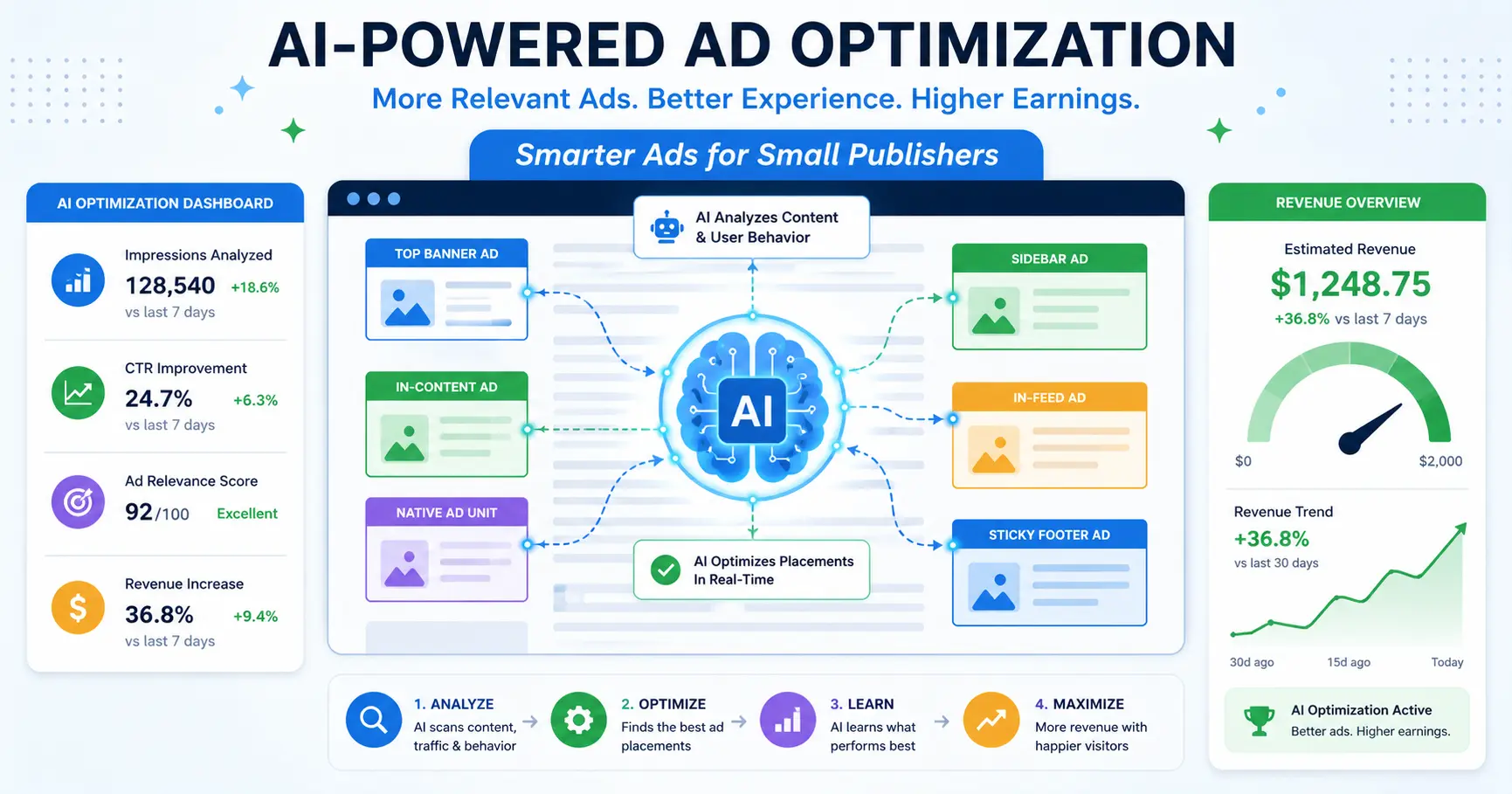
AdSense display ads but Ezoic optimizes the website’s ad setup.
It optimizes everything, Ad placements, layouts, and formats.
Ezoic experiments everything.
How Ezoic Works?
Let’s say you place an ad in your sidebar.
Most ad networks will simply leave it there and collect data.
Ezoic takes a different approach.
The system tests various ad configurations such as positions, quantities, and layouts. One should keep learning and experimenting.
The goal is simple: increase revenue without losing the user experience.
This is why Ezoic is popular.
How Much Can I make?
This is the basic question everyone wants answered.
The truth is that no ad network can guarantee earnings.
A technology blog with mostly US traffic will usually earn more than a general entertainment website with global traffic. The niche, audience location, and traffic quality all matter.
Many publishers earned more revenue with Ezoic than AdSense.
We heard publishers mentioning improvement and higher RPM after switching to Ezoic.
One should remember that results vary from site to site. So, never keep your expectations high.
Say, you are earning a few dollars per month with AdSense. In this case, you shouldn’t expect hundreds of dollars in revenue from Ezoic straightaway.
But if your traffic is growing steadily, Ezoic can be worth testing.
What We Liked About Ezoic?
The biggest advantage is that it gives smaller publishers access to technology that was once reserved for larger websites.
Advanced ad optimization is accessible to all, regardless of company size.
Another feature we like is Ezoic Leap.
We assume you spent time on Core Web Vitals. Site speed optimization is boring, isn’t it. Ezoic also improves speed and performance. Thereby it benefits both rankings and user experience.
Ezoic can work alongside other monetization methods instead of forcing you to rely on a single revenue source.
What We Don’t Like About Ezoic?
Let’s be honest.
Ezoic is not beginner friendly like AdSense.
AdSense integration involves embedding a code snippet into your website. Your job is done.
Ezoic requires a little more patience.
The dashboard contains a lot of settings, reports, and optimization options. Publishers appreciate that level of control. Some find it overwhelming.
It’s harder to learn than AdSense.
Publishers have expressed difficulties in fully optimizing earnings. Results aren’t always immediate because the platform needs data before it can make intelligent decisions.
Who Should Consider Ezoic?
Ezoic is not for a beginner who started a website last week. Obviously new sites will have no traffic.
Ezoic is a worthwhile consideration for rapidly growing sites seeking revenue beyond basic AdSense.
It’s particularly popular among:
- Bloggers
- Niche site owners
- Affiliate marketers
- Content publishers
- Growing media websites
Ezoic assists growing websites in transitioning from AdSense to more advanced ad networks such as Mediavine or Raptive, offering a strong monetization solution despite its drawbacks.
Chapter 4: Media.net — A Good Choice for Content Sites
Media.net is ideal for sites that have visitors from United States, United Kingdom, or Canada. If that’s your audience, it can help you make more money from your site.
What Is Media.net?
Media.net is an ad network that shows ads related to what your readers are looking at. It runs on Yahoo and Bing’s ad system. Media.net (Yahoo/Bing) and AdSense (Google) don’t compete with each other — they work well together. Lots of site owners use both.
Media.net is great if your visitors are mostly from the US or UK. It shows good-looking display ads and native ads (these are ads that blend in and look like part of your content). Because it uses “contextual advertising,” the ads match your content. Say for example, a travel related article will show travel ads, and a finance article will show finance ads. When ads are relevant, people click more, and you usually earn more.
Traffic and Approval Requirements
Media.net do not impose traffic restrictions, but it works much better if your site gets at least 5,000 to 10,000 visitors a month from top countries like the US, UK, or Canada. If most of your traffic comes from India, Southeast Asia, or Africa, you won’t earn as much — simply because advertisers spend less money there.
Getting approved takes a manual review, usually two to four weeks. Media.net is selective. Quality content, clean site, and good traffic improve approval odds.
How Much Can You Earn?
For a US audience, Media.net generally offers an RPM of $2-$8. Finance, legal, and tech websites tend to earn more. Many publishers who use both Media.net and AdSense say they earn more total than using just one — because the two networks compete to fill your ad space, which drives prices up.
Best Features
Media.net’s native ads blend in naturally with your content, so visitors don’t develop “ad blindness” — and that means more clicks. Their display ads include standard banners, in-content ads, sidebar ads, and sticky footer ads (these stay at the bottom of the screen).
All of these work on both desktop and mobile. Their reporting dashboard is clean and easy to use, showing live numbers for impressions, clicks, click-through rate, and earnings.
Minimum Payout: $100, paid through PayPal or wire transfer.
Chapter 5: PropellerAds — Start Today, Even with Zero Visitors
Look, if you don’t want to wait around for weeks just to get approved somewhere, PropellerAds is probably your move.
So, what even is it?
It’s a big ad network. Like, really big. Over 32,000 advertisers and billions of ads daily. But here’s the good part for you — they don’t care how little traffic you have. Zero visitors? Fine. They will accept you.
Sign up today, ads live by tomorrow.
What kind of ads?
Not your boring banner ads. They do stuff like:
Push notifications
Popunders
Full-screen ads that show up between pages
These types get way more clicks than normal ads. New sites can start earning right away.
Okay, but how much money?
Depends on where your visitors live and what ad type you use.
Push ads: around 50 cents to $2 for every 1,000 views if your traffic is from places like the US or UK
Popunders and full-screen ads: $1 to $4 for 1,000 views
The catch? These ads can be annoying. Like, really annoying sometimes. They make money, sure, but your visitors might get irritated.
Getting paid is easy
You only need $5 to cash out. And they pay you every week. Options include PayPal, Skrill, Payoneer, or bank transfer.
Why people like it?
You get approved right away
No traffic minimum — seriously, zero
Only $5 to withdraw
Weekly payments
Almost no other ad network gives you all four of those at once. So if you just started a site and want to see if it can actually make any money, PropellerAds is the fastest way to find out.
What’s not so great?
The ads can be pushy. Popunders and full-screen stuff might chase your visitors away if you overdo it.
PropellerAds isn’t as strict as AdSense, so some ads may look low‑quality or unusual. This could matter if your audience expects higher ad standards.
The minimum payout is $5. Payment methods are PayPal or Skrill.
Chapter 6: Adsterra — Perfect Fit for Global Audience
Adsterra is a lot like PropellerAds. Adsterra offers quick approval and requires no initial traffic. Its suitability depends on your audience’s geographical location, as certain features may be more beneficial.
What is Adsterra?
It’s a simple ad network. They approve you almost instantly, and they work well no matter which country your traffic comes from. We’re talking 195 countries. Every month, they show over 30 billion ads.
They also have a good system that catches fake traffic and bots. That means your earnings are cleaner, and you don’t have to worry about getting in trouble for invalid clicks.
Adsterra offers banners, native ads, popunders, full‑screen, and push ads like PropellerAds. But it shines by paying more for traffic outside the US and UK — making it a strong choice if your audience is in India, Brazil, or Southeast Asia.
What makes Adsterra different?
Social Bar – This is their own special ad format. It looks like little notification icons from social media. Gets more clicks than banners, without the annoyance of popunders. A good middle ground.
100% fill rate – No matter what your site is about, where your visitors are, or what time it is, Adsterra will always show an ad. You never waste an opportunity to earn.
Smart Direct Link – This lets you make money from traffic that doesn’t even need a real ad spot. Think people leaving your site, error pages, or redirect links. It’s a nice bonus.
Works with AdSense – You can run Adsterra and Google AdSense on the same site at the same time. Lots of small publishers do this to fill the empty ad spaces that AdSense doesn’t cover.
How do you get paid?
You only need $5 to cash out. You can use PayPal or Bitcoin. If you want a wire transfer, you’ll need to earn a bit more first.
Chapter 7: BidVertiser — A Solid Mix of Pay-Per-Click and Pay-Per-View for New Sites
BidVertiser is a bit different. It’s a mix of pay‑per‑click and pay‑per‑view, giving you more ways to earn from each visitor.
What Is BidVertiser?
BidVertiser is made for small and medium-sized site owners who want an easy way to make money. It’s known for being simple to set up, and it gives you several ad formats to choose from.
You can earn in three ways:
- Per views (CPM)
- Per click (CPC)
- Per action (CPA) – like someone signing up or buying something
The system picks the best way to earn from each ad — perfect if you’re unsure how visitors behave.
No traffic needed to start. Easy approval, simple dashboard, and multiple ad formats.
How Much Can You Make?
Honestly, the basic rates are just okay – usually between $0.50 and $2.00 per 1,000 views for visitors from rich countries like the US or UK.
BidVertiser works best as a backup. When AdSense or Ezoic don’t have an ad, it fills the space so nothing goes to waste.
Also, because they use real-time bidding, advertisers compete for your best visitors. Sites about money, investing, or tech get higher rates — even without big traffic.
Minimum Payout: $10 via PayPal or Bitcoin.
Chapter 8: Sovrn — The Hidden Gem for Dual Earnings
Most publishers have heard of AdSense and Ezoic. Far fewer have heard of Sovrn — which is exactly why it belongs on this list.
What Is Sovrn?
Sovrn is a technology platform offering dual monetization opportunities for publishers of all sizes with no minimum traffic requirement. The platform provides CPM-based display advertising through header bidding and Sovrn Commerce, which automatically converts existing product links into affiliate links.
That dual monetization angle is genuinely unusual. Most networks offer either display ads or commerce monetization. Sovrn gives you both from a single platform. Every existing product link in your content, whether you added it intentionally as an affiliate link or simply linked to a product as a reference can be automatically converted into a commission-generating affiliate link through Sovrn Commerce.
For content publishers who write product reviews, buying guides, or recommendation posts, this creates a second income stream running silently alongside their standard CPM display ads without requiring any additional content creation or link-building effort.
Who Is Sovrn Best For?
Sovrn works best as a secondary platform rather than a primary ad solution. Its display CPM rates, while competitive, are not consistently higher than AdSense or Ezoic. The real value is the Sovrn Commerce layer particularly for affiliate-focused sites like Way2earning.com, where product mentions and external links are already embedded throughout the content.
If your content naturally contains many product links, external tool references, or software recommendations, Sovrn Commerce can quietly generate additional commission income from links that are otherwise earning nothing.
Minimum Payout: $25 via PayPal or wire transfer.
Chapter 9: Infolinks — Best for Text Ads on Sites with Lots of Articles
If you write long articles and want to make money without cluttering your site with banner ads, Infolinks gives you something different.
What is Infolinks?
Infolinks turns certain words in your articles into ads. Instead of banners, it highlights keywords — when readers hover or click, a small ad appears. Your page stays clean, and ads only show if someone wants them.
The best part? You don’t need any minimum traffic to start. Infolinks also offers other ad types, like:
- InFold – small ads that sit at the bottom of the screen
- InTag – a cloud of keyword tags
- InFrame – ads in the empty space on the sides of your page
Its main strength is in‑text ads.
How much can I earn?
Infolinks pay less when compared to others. It ranges from $0.30 to $1.50 per 1,000 views. However, you can use along AdSense or Ezoic. It doesn’t cause conflicts with them. So, think of Infolinks as extra money on top of what you’re already making, not your main source of income.
For bloggers writing detailed, and keyword-rich guides Infolinks can passively generate $5 to $30 per month in additional income from content that is performing well.
Minimum Payout: $50 via PayPal, wire transfer, or eCheck.
Chapter 10: Monumetric — A Great Next Step Once You Hit 10,000 Views
All the other ad networks so far work for brand new sites. Monumetric doesn’t. You need at least 10,000 pageviews a month to get in. But once you hit that point, it’s one of the best earners out there for publishers who aren’t huge yet.
What is Monumetric?
This network uses header bidding to boost revenue for mid‑sized sites, often earning about 25% more than AdSense. It offers a low payout minimum and ads blend in naturally.
With Monumetric, it’s not just header bidding. They also mix in direct ad deals and private marketplaces. All that competition usually pushes your CPM higher than what AdSense or basic networks can offer.
What can you actually earn?
Most Monumetric publishers see RPMs between $3 and $12 for traffic from countries like the US, UK, or Canada. If you’re in a high-paying niche like personal finance or tech, you might hit $15+. That 25% boost over AdSense? Independent publishers say it’s real.
They also do free site audits and suggest tweaks to help your ads and site speed. That’s extra value — not just “paste this code and good luck.”
Minimum traffic required: 10k pageviews per month
You should reach at least $10 in earnings for withdrawal. The options are PayPal and bank transfer.
Chapter 11: How to Pick the Right Ad Network for Your Site?
You now know ten good CPM and CPC networks for smaller sites. But how do you choose — or combine them? Here’s a simple perspective.
1. Your current traffic
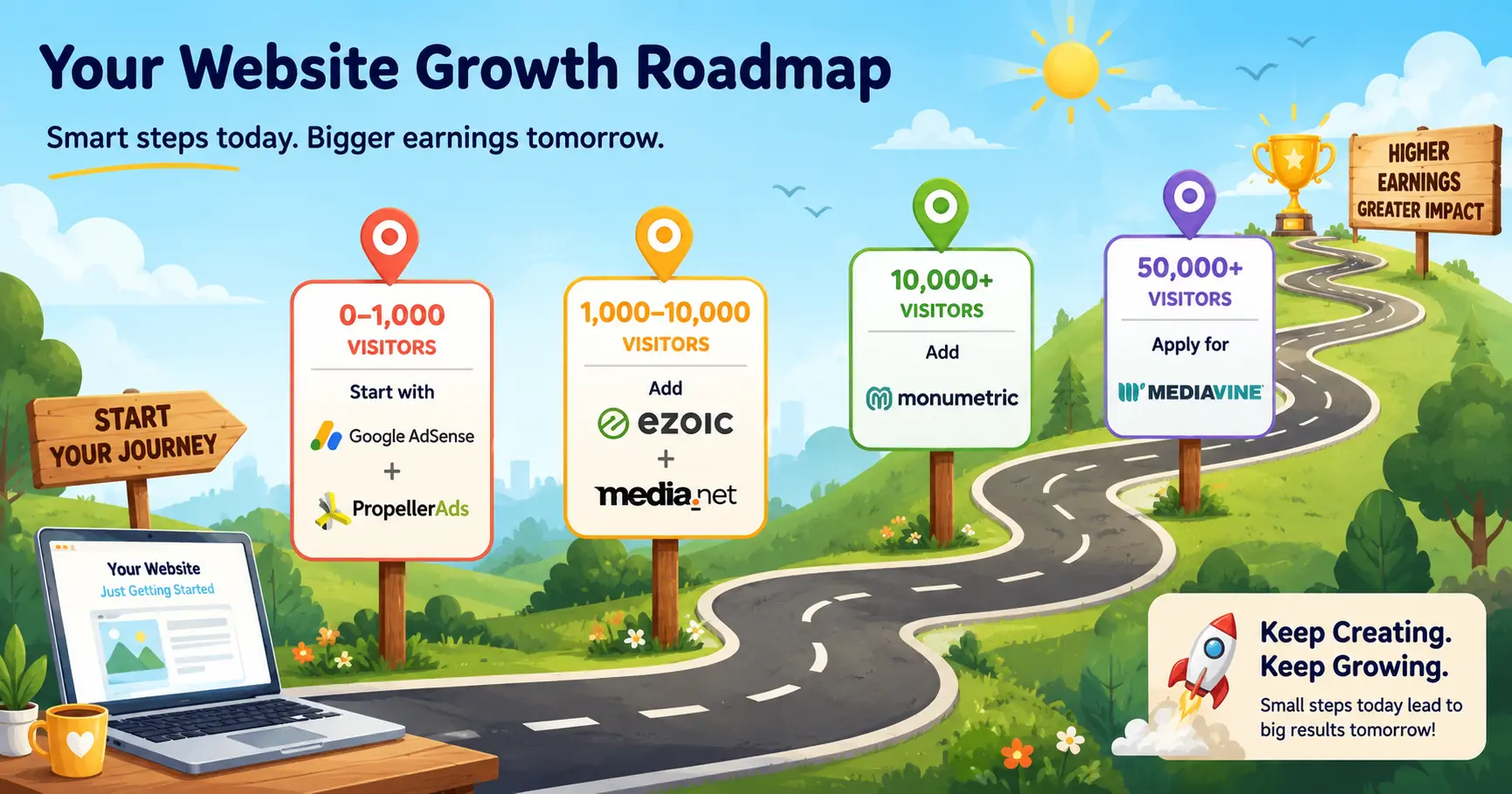
Under 1,000 visitors? AdSense or PropellerAds is the way to go. They accept new sites without traffic minimums and provide valuable data for growth.
For 1k-10k monthly visitors, one must try Ezoic along with AdSense. Test if their AI actually lifts your RPM. For most people in this range, it does.
Over 10,000 pageviews: Apply to Monumetric. That’s your ticket to better earnings from header bidding and direct deals.
2. Where your traffic comes from
Networks like Media.net work best for US, UK, and Canadian traffic. If most of your readers are in India, Southeast Asia, or Africa, go with Adsterra or PropellerAds — they outperform contextual networks for those regions.
3. Your niche and how sensitive your audience is
Ad types vary by blog niche. Most ads work well for finance, affiliate, and tech blogs. However, health, parenting, and wellness sites need cleaner ad formats such as AdSense or Ezoic, and should avoid pop-ups.
4. How fast you want to get paid
Need small payments quickly? Pick PropellerAds ($5 minimum, weekly), Adsterra ($5), or BidVertiser ($10). Don’t mind waiting monthly for a higher threshold? AdSense ($100) and Media.net ($100) have better quality ads.
The stacking strategy (works best)
Don’t pick just one network. Overlap them to cover gaps. Simple starter stack for low-traffic sites:
- Primary: Google AdSense or Ezoic for clean, & high-quality ads
- Secondary: Media.net captures Bing and Yahoo ad revenue. AdSense misses it.
- Supplemental: Infolinks: in-text ads that complement banners
- Fill layer: Adsterra or PropellerAds (grabs any leftover empty ad space)
This layered setup boosts your fill rate, increases advertiser competition, and monetizes every pageview.
FAQ
Q1: Which ad network should I use for a small website?
New sites with low traffic should start with AdSense. It’s trusted, beginner‑friendly, and works for most websites.
Another good option is PropellerAds because it accepts small websites quickly and lets you withdraw earnings starting from only $5.
If you’re just starting your blogging journey, these two are simple and safe choices.
Q2: Can I use multiple ad networks simultaneously?
Yes, of course. See, many bloggers use more than ad network for the extra income. For example, AdSense is into Display ads and Infolinks shows text ads. You can combine both to earn good income.
Just make sure the networks you use allow combination setups.
Q3: How much can a site with 5k visitors earn?
The ad earnings vary by topic, audience, and setup. Small blogs with 5k monthly views usually make $10–$50. Visitors from the US, UK, and Canada are worth more.
Q4: Which ad network pays the fastest?
PropellerAds is known for fast payments and low payout limits. You can withdraw once you reach $5, and payments are available weekly.
Adsterra is also popular among beginners because of its low payout requirement.
Networks like AdSense usually pay once every month.
Q5: Can a new website get approved by AdSense?
Yes, new websites can get approved.
But your site should look complete before applying. That means:
- Original articles
- Easy navigation
- Important pages like About and Privacy Policy
- Useful content for readers
Bloggers typically apply after creating 15–20 high-quality posts.
Q6: What exactly is RPM?
RPM tells you what you earn per thousand. $5 RPM means $5 per thousand. This helps you easily understand your ad performance.
Q7: Is Ezoic really better than AdSense?
For many bloggers, it is.
When I first tried Ezoic, I noticed the earnings were higher than regular AdSense on some pages. The reason is simple — Ezoic keeps testing different ad positions automatically to see what performs best.
It is not perfect for everyone.
Some beginners find Ezoic setup tricky compared to AdSense, which is mostly copy‑paste. But if your traffic keeps growing, the extra effort is worthy.
Q8: Can I use AdSense along with Adsterra?
Yes, many bloggers do exactly that.
A lot of small publishers use AdSense for high-quality display ads and then add Adsterra to monetize the traffic AdSense doesn’t fully cover.
This setup works well for sites with mixed global traffic. Just don’t pack in too many ads, or visitors may get annoyed and leave.
Q9: Which ad network works best for Asian traffic?
If most of your visitors come from countries like India, Pakistan, Indonesia, or the Philippines, networks like PropellerAds and Adsterra often perform better.
I’ve seen many bloggers struggle with Media.net because it mainly works best with US and UK traffic. Media.net is solid, but if most of your audience is in Asia, earnings may be lower.
The best network always depends on where your readers are coming from.
Q10: What should I do before qualifying for Mediavine?
Don’t wait for premium networks before monetizing your blog.
Most bloggers start with AdSense. As traffic grows, they try Ezoic or Media.net. If a site gets 10k views, Monumetric will be a good option.
It is like levels in a game. You slowly move from beginner networks to higher-paying ones as your traffic increases.
Q11: Are pop-under ads safe to use?
Technically, yes — but they should be used carefully.
Some website owners use pop-under ads without any issues. Others notice that visitors get irritated and leave the site faster.
This is the real problem.
Extra ad money isn’t worth annoying visitors. If you use pop‑unders, test them slowly and watch bounce rate and visitor behavior.
Q12: How long does AdSense approval take?
Mostly AdSense approval takes around one to two weeks.
Google reviews your website manually during this time.
Websites with clean design, useful content, and proper pages usually get approved faster.
Final Conclusion
Making money from a low-traffic website is not some overnight success trick. In the beginning, the earnings are usually small. Some months may even feel disappointing. But that doesn’t mean display ads don’t work.
Ad revenue grows slowly with your traffic and content. A blog making $5 today can reach hundreds or even thousands per month if you keep publishing. That’s why it’s smart to start monetizing early instead of waiting until your site feels ‘big enough.’
The networks in this guide give beginners a clear step‑by‑step path. For most people, AdSense is the best starting point — it’s trusted, beginner‑friendly, and easy to set up. Since Google shifted AdSense toward CPM earnings, even small sites can earn better than before.
Once your traffic starts growing, you can test other networks too.
For example:
Ezoic is worth trying after your site starts getting regular traffic because its AI system can sometimes improve earnings automatically.
Media.net works well if most of your audience comes from countries like the US or UK.
PropellerAds and Adsterra can help monetize extra traffic that other networks may not fully cover.
Infolinks adds a small extra income without changing your site much. Once you reach about 10k monthly views, Monumetric is a solid upgrade. Many bloggers expect big results too fast. Actually, growth takes time.
But website income usually works like a snowball. At first, growth feels slow. Then your traffic increases, your content library grows, and your earnings slowly start compounding month after month.
Every successful blog earning serious money today started from zero traffic at some point.
The difference is that those website owners kept publishing, kept learning, and kept improving over time.
You already have the tools to begin.
Now it comes down to one thing — continuing to create useful content people actually want to read.
